

Abstract
Cobalt-based hardfacing alloys are extensively employed to enhance the wear, corrosion, and high-temperature performance of critical components used in power generation and valve industries. However, the deposition of cobalt-based weld overlays on Grade 91 (9Cr–1Mo–V) steel is frequently associated with metallurgical challenges such as excessive dilution, residual stress accumulation, delayed cracking, and interfacial delamination, which significantly compromise service reliability. In the present study, a systematic investigation was carried out to evaluate the feasibility of producing defect-free cobalt-based hardfacing overlays on grade 91 steel using Hot-Wire Pulsed Tungsten Inert Gas (TIG) welding and metal-cored wire hardfacing, with the incorporation of an Inconel 82 buffer layer. Hardfacing experiments were performed on P91 steel pipe specimens under controlled welding conditions, followed by post-weld heat treatment in accordance with ASME and ISO standards. The integrity of the weld overlays was assessed through visual inspection, liquid penetrant testing, ultrasonic examination, hardness profiling, chemical composition analysis, and detailed microstructural characterization. The results demonstrated sound metallurgical bonding between the substrate, buffer layer, and hardfacing overlay, with no evidence of porosity, cracking, or debonding, including under delayed inspection conditions.
The Stellite 6 hardfacing layers exhibited high and uniform hardness in the range of 437–450 HV10, attributed to the formation of a carbide-reinforced cobalt–chromium–tungsten solid solution matrix. Chemical analysis confirmed effective control of dilution and stabilization of alloy chemistry across the overlay thickness. Microstructural evaluation revealed a favorable hardness gradient from the P91 substrate through the buffer layer to the hardfacing surface, minimizing stress concentration at the interface. The incorporation of the Inconel 82 buffer layer was found to be effective in suppressing the formation of detrimental interfacial microstructures and improving coating integrity. The findings of this study provide valuable insights into the development of reliable cobalt-based hardfacing strategies for Grade 91 steel components intended for high-temperature and wear-critical applications.
Introduction
In industrial practice, hardfacing is commonly applied to carbon steels, low-alloy steels, stainless steels, duplex and super duplex stainless steels (Deshmukh and Kalyankar, 2018, 2019), as well as nickel-based alloys, where an anti-wear and anticorrosive layer is required. The process involves depositing a specialized alloy onto vulnerable substrates to improve resistance against aggressive operating environments (Bhoskar et al., 2024). In valve manufacturing and power plant applications, hardfacing is extensively employed on trim components such as valve discs and seats, which are exposed to continuous metal-to-metal contact under elevated temperatures and pressures (Deshmukh and Kalyankar, 2019, Kalyankar et al., 2021; Kakade et al, 2022).
Several studies have investigated the microstructural evolution and performance of hardfaced alloys deposited using arc welding processes. Chang et al. (2013) examined high-carbon Fe–Cr–C hardfacing alloys deposited by gas tungsten arc welding (GTAW) and reported that increased carbide fraction significantly enhanced hardness and abrasive resistance. Madadi et al. (2011)
demonstrated that welding current plays a dominant role in controlling heat input and dilution during TIG-based Stellite 6 hardfacing on carbon steels. Kashani et al. (2007) reported improved high-temperature wear resistance of Stellite overlays on Inconel 625, attributing the performance to compacted oxide layers supported by work-hardened regions. Gholipour et al. (2011) identified epitaxial dendritic growth and carbide-rich Co-based matrices in Stellite 6 overlays deposited on stainless steel, with hardness increasing from the interface toward the coating surface. Despite these advances, limited studies have focused on addressing the specific challenges associated with cobalt-based hardfacing on Grade 91 steel, particularly under arc welding conditions relevant to industrial valve manufacturing. In service, Stellite coatings are exposed to high-temperature steam environments (≈560–600 °C), where natural aging and stress accumulation can lead to coating delamination and delayed cracking. Recent power plant failures have highlighted the urgent need to improve weld overlay integrity and long-term reliability of cobalt-based hardfaced components on Cr–Mo steels. One promising approach to mitigate these issues involves the use of buffer layers between the substrate and the hardfacing alloy to reduce dilution, residual stresses, and metallurgical incompatibility.
However, uncertainties remain regarding the selection of suitable welding processes, buffer layer materials, and acceptable dilution limits to ensure defect-free overlays. Therefore, a systematic evaluation of advanced welding techniques with improved heat input control is required. In this context, the present investigation focuses on the development and characterization of cobalt-based alloy weld overlays deposited on 9Cr–Mo steel using Hot-Wire Pulsed TIG and Metal-Cored Wire Welding processes. The study aims to assess the effectiveness of these processes in controlling dilution, minimizing cracking and delamination, and producing sound metallurgically bonded overlays. Furthermore, the applicability of buffer layers in enhancing coating integrity and service reliability is examined, with the ultimate objective of improving hardfacing performance for high-temperature valve and power plant applications.
Experimental Approach
2.1 Substrate Material
The substrate material employed in the present investigation was high-alloy ferritic–martensitic steel P91, commonly designated as F91, C12A, or Grade 91 in various material specifications. The material was supplied in the form of a hollow cylindrical component with an outer diameter of 162 mm, an inner diameter of 132 mm, and a length of 150 mm. P91 steel is a specially modified and heat-treated 9Cr–1Mo–V alloy developed for high-temperature applications, offering superior creep strength, oxidation resistance, and microstructural stability at service temperatures typically exceeding 537 °C. The nominal chemical composition and mechanical properties of the P91 base material are presented in Table 1. The alloy contains controlled additions of chromium, molybdenum, vanadium, and nitrogen, which contribute to precipitation strengthening and enhanced high-temperature performance. In the normalized and tempered condition, the material exhibits high yield strength, adequate ductility, and resistance to thermal degradation, making it a preferred choice for power plant components such as valves, steam piping, and boiler
systems.
Table 1. Chemical Composition and Mechanical Properties of P91 Steel
Category
Property / Element
Specification / Value
Chemical composition
Carbon (C)
0.08–0.12
Manganese (Mn)
0.30–0.60
Phosphorus (P)
≤0.020
Sulfur (S)
≤0.010
Silicon (Si)
0.20–0.50
Nickel (Ni)
≤0.40
Chromium (Cr)
8.00–9.50
Molybdenum (Mo)
0.85–1.05
Aluminum (Al)
≤0.02
Vanadium (V)
0.18–0.25
Titanium (Ti)
≤0.01
Zirconium (Zr)
≤0.01
Nitrogen (N)
0.030–0.070
Mechanical properties
Yield Strength
568
Ultimate Tensile Strength
710
Elongation
24
Minimum Design Metal Temperature
−20
Heat Treatment Condition
Normalized & tempered
2.2 Buffer Material – Inconel 82 (ERNiCr-3)
Inconel 82 (ERNiCr-3) filler metal was selected as the buffer layer material to mitigate metallurgical incompatibility between the P91 substrate and the cobalt-based hardfacing alloy. The nominal chemical composition and mechanical properties of Inconel 82 are listed in Table 2. This nickel–chromium–iron alloy is widely used for welding nickel-based alloys to themselves, as well as for dissimilar metal welding involving steels, stainless steels, and nickel-based alloys.
Table 2. Chemical Composition of Inconel 82 (Buffer Material)
C
Mn
Fe
P
S
Si
Cu
Ni
Ti
Cr
Nb + Ta
Other
0.10
2.5
3.0
0.03
0.015
0.50
0.50
67.0
0.75
18.0
2.0
0.50
ERNiCr-3 filler metal is commonly employed in surfacing applications, cladding of steel components with nickel-based alloys, and joining operations using GTAW, GMAW, SAW, and PAW processes. The high nickel content ensures excellent ductility, resistance to hot cracking, and improved stress accommodation, while chromium provides enhanced oxidation and corrosion resistance. The use of Inconel 82 as a buffer layer is particularly advantageous in reducing dilution effects, minimizing residual stresses, and improving the adhesion and service reliability of
subsequent cobalt-based hardfacing layers.
2.3 Hardfacing Material
The hardfacing alloy employed in this study was Stoodite 6, supplied in the form of an ERCCoCr-A metal-cored wire. Weld deposits produced using this alloy are characterized by a hypoeutectic microstructure comprising a cobalt–chromium–tungsten solid solution matrix reinforced by approximately 13% eutectic chromium carbides. This microstructural configuration provides an optimal balance between hardness, wear resistance, and toughness.
Stoodite 6 exhibits excellent resistance to low-stress abrasive wear and metal-to-metal sliding, particularly under high load conditions where galling is a concern. Additionally, the alloy demonstrates superior resistance to corrosion, oxidation, and retention of hot hardness at elevated temperatures up to approximately 650 °C (1200 °F). Owing to the absence of allotropic phase transformations, cobalt-based alloys retain their mechanical and tribological properties even after subsequent heat treatment of the base material. The chemical composition of the Stoodite 6
hardfacing alloy is presented in Table 3.
Table 3. Chemical Composition of Stoodite - 6 (Hardfacing Material)
C
Cr
Fe
Mn
Mo
Ni
Si
Ti
Co
1.2
29.0
2.1
0.05
0.10
2.0
1.2
4.7
Bal
2.4 Hardfacing using TIG
Hardfacing experiments were conducted on pipe specimens with dimensions of 162.0 mm outer diameter, 132.0 mm inner diameter, and 150 mm length. A total hardfacing overlay thickness of approximately 7.0 mm was deposited using the welding parameters. Fully automated compact cladding cell based on hot-wire pulsed Tungsten Inert Gas (TIG) welding technology. The system, manufactured by Fronius India Pvt. Ltd., was equipped with a programmable logic controller (PLC) and a touch-screen interface for precise control of welding parameters.
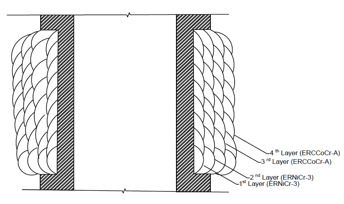
The TIG hardfacing process was performed under mechanized conditions to ensure process repeatability and consistent weld quality. The welding parameters were maintained as follows: welding current of 210 A, arc voltage of 14 V, travel speed of 19 cm/min, shielding gas flow rate of 12 L/min, and hot-wire feed rate of 190 cm/min. These parameters were selected to achieve stable arc conditions, controlled heat input, uniform deposition, and sound metallurgical bonding between the substrate, buffer layer, and hardfacing alloy. Figure 1 and 2 shows the plan of
hardfacing on the coupon.

Fig. 1. Welding Sequence

Fig. 2. Actual Hard-faced Sample
3. Results and Discussion
Following hardfacing, the welded components were subjected to post-weld heat treatment (PWHT) in accordance with the time–temperature requirements specified in UCS-56 of ASME Section VIII, Division 1, and ISO 13480 Part 4. Subsequently, test coupons were extracted by machining on a conventional lathe, while sectioning was performed using a power hacksaw. Final test specimens were prepared as per the requirements of ASME Section IX. Visual inspection of the weld overlays revealed smooth and uniform deposits, free from surface defects such as porosity, visible cracks, undercut, or microsegregation. Hence, the weld overlays were accepted for further evaluation. Liquid penetrant testing (LPT) was performed after PWHT in accordance with QW-195.2 of ASME Section IX. The inspection results indicated no recordable linear or rounded indications, confirming the soundness of the deposited overlays. After machining, the chemical composition of the deposited hardfacing layer was verified using positive material identification (PMI) analysis. The results confirmed compliance with the chemical composition requirements specified for ERCoCr-6 (Stellite 6) as per AWS standards. A detailed quantitative chemical analysis of the weld metal was subsequently conducted in a laboratory environment to assess elemental distribution across the overlay thickness. Ultrasonic testing (UT) was carried out to assess the integrity of the metallurgical bond between the P91 substrate, Inconel 82 buffer layer, and Stellite 6
hardfacing overlay. The inspection revealed no evidence of debonding, lack of fusion, or internal discontinuities at the interfaces between the deposited layers. These results confirm effective metallurgical bonding throughout the multi-layer weld overlay system.
3.1 Hardness Testing
Vickers hardness measurements were performed using a digital hardness tester with a load of HV10. Hardness evaluation was conducted across the transverse cross-section of the weld overlay to assess the hardness gradient from the substrate to the hardfacing surface. Each specimen was divided into three regions—top, middle, and bottom—perpendicular to the welding direction. Hardness values were measured at multiple locations within each region, and average values were calculated. The results, summarized in Table 4, show a progressive increase in hardness from the base material through the heat-affected zone (HAZ) and buffer layer to the hardfacing overlay. The Stellite 6 hardfacing layers exhibited high hardness values in the range of 437–450 HV10, attributable to the presence of carbide-rich microstructures. The buffer layer exhibited intermediate hardness, while the HAZ and parent material showed comparatively lower hardness values, indicating a favorable hardness gradient that helps in reducing stress concentration and cracking susceptibility.
Table 4. Micro Hardness test results
Type/Load
Location
Hardness (HV10)
HV 10
4th layer (Hard Facing) – 7 mm from FL (Top of HFO)
442,437,450
HV 10
3rd layer (Hard Facing) – 6 mm from FL
437,442,450
HV 10
3rd layer (Hard Facing) – 5 mm from FL
446,450,450
HV 10
2nd (Buffer layer) – 4 mm from FL
357,351,345
HV 10
2nd (Buffer layer) – 3 mm from FL
333,336,339
HV 10
HAZ (Within 1 mm from Fusion Line)
203,207,212
HV 10
Parent Material
207,206,206
3.2 Chemical Composition Analysis
Chemical composition analysis of the deposited weld metal was carried out on machined specimens at various distances from the fusion line, ranging from 3.0 mm to 7.0 mm. The results indicate a gradual stabilization of alloying elements with increasing distance from the fusion line. Higher iron content was observed near the fusion boundary due to dilution from the P91 substrate, whereas the cobalt, chromium, and tungsten contents increased toward the top layers of the hardfacing overlay. The elemental distribution confirms as shown in Table 5, effective control of dilution and validates the role of the Inconel 82 buffer layer in minimizing iron pickup and maintaining the desired chemistry of the Stellite 6 hardfacing alloy. Deposited weld metal chemical Analysis is done in machined condition of weld overlay.
Table 5. Elemental distributions of elements from the weld fusion line in hardfaced specimen
Sr.
No.
Weld Thickness/ % Composition
3.0 mm from weld fusion Line
4 mm from weld fusion Line
5 mm from weld fusion Line
6 mm from weld fusion Line
7 mm from weld fusion Line
1
C
1.14
1.12
1.13
1.22
1.21
2
Mn
1.69
1.46
1.63
1.14
1.08
3
P
0.012
0.013
0.010
0.013
0.012
4
S
0.038
0.006
0.025
0.048
0.014
5
Si
0.82
0.93
0.78
1.03
1.08
6
Cr
25.17
25.82
24.68
26.40
26.90
7
Ni
19.52
12.21
18.13
8.54
6.69
8
Cu
0.10
0.11
0.58
0.36
0.31
9
Mo
0.60
0.51
0.10
0.13
0.13
10
Fe
10.62
8.31
11.21
5.50
5.50
11
W
2.92
3.80
3.13
4.56
4.56
12
Co
Bal
Bal
Bal
Bal
Bal
3.3 Microstructural Observations
Microstructural examination was carried out across different regions of the weldment, including the parent material, heat-affected zone, buffer layer, and hardfacing overlay.
Parent Material: The base metal exhibited a tempered martensitic structure within a ferritic matrix, consistent with the normalized and tempered condition of P91 steel.
Heat-Affected Zone (HAZ): The HAZ displayed a microstructure similar to the parent material, though with slightly coarser grains due to thermal exposure during welding.
Buffer Layer: The Inconel 82 buffer layer showed a dendritic microstructure along with regions of tempered martensite, indicating effective metallurgical compatibility between the substrate and the hardfacing layer.
Hardfacing Overlay: The Stellite 6 overlay exhibited a dendritic microstructure consisting of primary and secondary carbide networks uniformly distributed within a cobalt–chromium–tungsten solid solution matrix. The overlay was free from microcracks, porosity, or other metallurgical defects.
3.4 Macrostructural Observations
Macrostructural examination of the weld cross-sections revealed complete fusion between the substrate, buffer layer, and hardfacing overlay. No macro-level defects such as cracks, lack of fusion, or incomplete penetration were observed, confirming the overall integrity of the weld overlay system. To evaluate the susceptibility of the hardfaced components to delayed cracking and delamination, liquid penetrant testing was repeated on selected samples after 15 days of hardfacing. The inspection revealed no recordable indications, demonstrating the absence of delayed cracking and confirming the long-term stability of the deposited overlays.
4. Conclusions
The present investigation successfully demonstrated the deposition of defect-free cobalt-based hardfacing overlays on Grade 91 steel using a buffer layer approach. Advanced characterization of the interface between the buffer layer and the substrate revealed that cracking susceptibility is strongly influenced by the formation of hard, continuous lamellar microstructures enriched in iron–cobalt and chromium-rich phases. The significant localized increase in hardness within this interfacial region can reduce damage tolerance and promote crack propagation under service conditions. The use of an Inconel 82 buffer layer effectively minimized dilution, reduced residual stresses, and improved metallurgical compatibility between the P91 substrate and Stellite 6 hardfacing alloy.
Ultrasonic testing, hardness profiling, chemical composition analysis, and microstructural evaluation confirmed sound bonding, controlled hardness gradients, and uniform elemental distribution across the weld overlay system. Furthermore, the absence of delayed cracking and delamination after extended inspection validates the reliability of the adopted hardfacing strategy. The findings emphasize the importance of buffer layer selection and precise control of welding parameters to prevent the formation of detrimental microstructures, such as sigma phase, in cobalt-based hardfaced components. The results provide valuable insights for improving the service performance of hardfaced Grade 91 steel components used in high-temperature power plant and valve applications.
References
ASME Sec II part C; Specifications for Welding rods, electrodes & filler metals.
ASME Sec IX;Qualification Standard for Welding, Brazing, and Fusing Procedures; Welders; Brazers; and Brazing and Fusing Operators
Bhoskar, A., Kalyankar, V., & Deshmukh, D. (2024). Implications of FCC and HCP cobalt phases on wear performance of weld deposited cobalt-based coating. Results in Surfaces and Interfaces, 16, 100247.
Chang, J. et al. (2013) ‘Microstructure and Abrasive Wear Properties of Fe-Cr-C Hardfacing Alloy Cladding Manufactured by Gas Tungsten Arc Welding ( GTAW )’, 19(1), pp. 93–98. doi: 10.1007/s12540-013-1015-4.
Deshmukh, D. D., & Kalyankar, V. D. (2018). Recent status of overlay by plasma transferred arc welding technique. International Journal of Materials and Product Technology, 56(1-2), 23-83.
Deshmukh, D. D., & Kalyankar, V. D. (2019). Deposition Characteristics of Multitrack Overlayby Plasma Transferred Arc Welding on SS316Lwith Co-Cr Based Alloy–Influence of Process Parameters. High Temperature Materials and Processes, 38(2019), 248-263.
Deshmukh, D. D., & Kalyankar, V. D. (2021). Analysis of deposition efficiency and distortion during multitrack overlay by plasma transferred arc welding of Co–Cr alloy on 316L stainless steel. Journal of Advanced Manufacturing Systems, 20(04), 705-728.
Deshmukh, D. D., Kakade, S. P., & Bhoskar, A. (2025). Advanced Manufacturing Perspectives on NiCrBSiC Hardfacing: Microstructural and Wear Performance Analysis. Transactions of the Indian Institute of Metals, 78(7), 160.
Gholipour, A., Shamanian, M. and Ashrafizadeh, F. (2011) ‘Microstructure and wear behavior of stellite 6 cladding on 17-4 PH stainless steel’, Journal of Alloys and Compounds. Elsevier B.V., 509(14), pp. 4905–4909. doi: 10.1016/j.jallcom.2010.09.216.
Kakade, S. P., Thakur, A. G., Deshmukh, D. D., & Patil, S. B. (2023). Experimental investigations and optimisation of Ni-Cr-B-Si hardfacing characteristics deposited by PTAW process on SS 410 using response surface method. Advances in Materials and Processing Technologies, 9(3), 826-842.
Kalyankar, V., Bhoskar, A., Deshmukh, D., & Patil, S. (2022). On the performance of metallurgical behaviour of Stellite 6 cladding deposited on SS316L substrate with PTAW process. Canadian Metallurgical Quarterly, 61(2), 130-144.
.jpg&w=3840&q=75)

.jpg&w=3840&q=75)
.png&w=3840&q=75)